German employment law and illness – explained simply
How many sick days do you have left?
When your employer must offer you a BEM meeting, how long you receive continued pay, and when a dismissal due to illness is possible – explained simply for employees in Germany.
The key figureThe 6-week limit
In German employment law, the same figure keeps coming up when you are ill: six weeks within twelve months. If you are off sick for longer, your employer must offer you workplace reintegration management (Betriebliches Eingliederungsmanagement, BEM). The same limit also serves as a guide when it comes to whether a dismissal due to illness is possible – but then looked at over several years (more under Dismissal).
The count is rolling: what matters is the last twelve months from today, not the calendar year. Six weeks are not always 30 days – for repeated short illnesses, it depends on how many days a week you work:
| Workdays per week | 6 weeks equal |
|---|---|
| 6-day week | 36 workdays |
| 5-day week | 30 workdays |
| 4-day week | 24 workdays |
| 3-day week | 18 workdays |
| 2-day week | 12 workdays |
For one continuous period of incapacity, calendar days count: the limit is exceeded after more than 42 days in a row – weekends included.
Workplace reintegration managementWhat is a BEM – and when are you entitled to it?
If you were unable to work for more than six weeks within twelve months – in one go or in several periods – your employer must offer you a BEM. Together you work out how the incapacity can be overcome, how a new illness can be prevented and how your job can be kept.
- For all employees – not only for people with severe disabilities, and regardless of the size of the company.
- Voluntary for you: your employer must offer the BEM, but you may decline it or stop at any time.
- Not alone: you can bring a person of trust of your choice; the works or staff council and – if you have a severe disability – the representative for severely disabled employees are involved if you agree.
- Data protection: you must be informed in advance about the aims of the BEM and the data collected for it. You do not have to disclose your diagnosis.
After the BEM, the count starts again
After a completed BEM, only the days of absence afterwards count. If you are again unable to work for more than six weeks within a year after it was completed, a new BEM must generally be offered (Federal Labour Court, judgment of 18 Nov 2021 – 2 AZR 138/21).
This does not automatically make a dismissal invalid. In an unfair dismissal case, however, the employer must then show in detail that a BEM could not have prevented the dismissal either – a high hurdle.
Continued pay during illnessSix weeks of full pay – and then?
If you are unable to work due to illness, your employer continues to pay your full salary for up to six weeks – that is 42 calendar days. The condition is that your employment has already lasted four weeks without interruption.
The same illness is added up
If you repeatedly fall ill with the same illness, the periods are added together – you only get the 42 days once. You only have a new entitlement to six weeks if
- you were not unable to work because of this illness for at least six months before falling ill again, or
- twelve months have passed since the start of the first incapacity due to this illness.
A new, different illness generally triggers a new entitlement to six weeks – unless it starts while you are still on sick leave for the first one. Then both count as a single case of illness.
From day 43: sickness benefit
§ 47 SGB V§ 48 SGB VWhen continued pay ends, the statutory health insurance fund steps in for those insured with it. Sickness benefit (Krankengeld) amounts to 70 % of your gross salary, but no more than 90 % of your net salary; social security contributions are then deducted. For the same illness, sickness benefit is paid for a maximum of 78 weeks within three years – the weeks of continued pay are included.
To the sickness benefit calculator →
Your duties when you call in sick
§ 5 EFZG- Report it immediately: tell your employer without delay that you are ill and how long it is likely to last.
- See a doctor by day 4 at the latest: if the illness lasts longer than three calendar days, you need a medical certificate by the following workday at the latest. Your employer, employment contract or collective agreement may require it earlier, for example from the first day. If you are ill for longer than certified, you need a new certificate.
- eAU: for people with statutory health insurance, the employer retrieves the electronic sick note directly from the health insurance fund. The employer does not learn the diagnosis.
Sickness benefit calculator 2026How much sickness benefit will I get?
Roughly how much sickness benefit (Krankengeld) will you get from day 43? The amount is set by law and is the same at every statutory health insurance fund – you don't need to choose your fund.
Your regular monthly pay according to your payslip, without one-off payments.
No sickness benefit for, among others, mini-jobbers, family-insured persons and people receiving a full old-age pension. Privately insured persons may receive a daily sickness allowance (Krankentagegeld) under their contract.
Non-binding estimate using the 2026 values, not legal advice. The decision of your health insurance fund is what counts. Your entries stay in your browser – nothing is stored or sent.
→ Sickness benefit calculator 2026: To the sickness benefit calculator ↗
Dismissal for personal reasonsCan you be dismissed because of illness?
Yes – but only under strict conditions. If the Dismissal Protection Act (Kündigungsschutzgesetz) applies to you (as a rule: more than ten employees in the business and your employment has lasted more than six months), labour courts examine a dismissal due to illness in three stages. All three must be met:
- Negative health prognosis
Your past absences must indicate that you will continue to be absent to a considerable extent in the future. A common rule of thumb is absences of more than six weeks in each of roughly the last three years.
- Significant impact on the business
The absences must lead to serious disruption of operations or high economic costs – for example continued pay costs of more than six weeks per year.
- Balancing of interests
In the individual case, the employer's interest must outweigh yours in keeping your job – taking into account, for example, length of service, age, cause of the illness and whether a BEM was offered.
In small businesses with up to ten employees and in the first six months of your employment, the three stages do not apply (§ 23 KSchG). Your employer can then dismiss you because of illness – even during sick leave – without having to give a specific reason. Arbitrariness and discrimination, for example because of a disability, remain prohibited. The notice period still applies.
The three-year rule of thumb applies to frequent short illnesses. For a long illness, labour courts ask whether you can be expected to recover in the foreseeable future. If no improvement is foreseeable within the next 24 months, or you can permanently no longer do your job, a dismissal can be justified even without a history over several years – if there is no other suitable job for you in the company.
If you are severely disabled or have equal status to a severely disabled person, your employer needs the approval of the Integration Office (Integrationsamt) before dismissing you (§ 168 SGB IX). Pregnant women, employees on parental leave and works council members are also specially protected.
You must file an unfair dismissal claim with the labour court within three weeks of receiving notice (§ 4 KSchG). After that, the dismissal is generally deemed effective – even if it would actually have been invalid. Get advice early, for example from a lawyer specialising in employment law or from your trade union.
Find out your absencesWhere do I get my sick days from?
Your doctor’s practice sends every sick note electronically to your health insurance fund (eAU). At most funds you can see the list directly in the app – and you always have the right to request an overview. Choose your fund:
Your health insurance fund
TK – Techniker Krankenkasse
- App: TK-App → „Übersichten“ → „Krankmeldungen“
- Online: „Meine TK“ → „Meine Krankmeldungen“
- Phone: 0800 285 85 85
- They also send you a written overview – with or without diagnoses and for a specific period if you like.
AOK (alle regionalen AOKs)
- App: „Meine AOK“ (App oder meine.aok.de) → Krankmeldungen
- Sick notes of the last four years with duration and main diagnosis.
- Child sick days are listed there too – but they do not count as your own sick days.
BARMER
- App: BARMER-App oder „Meine BARMER“ → „Meine Leistungen“ → „Arbeitsunfähigkeitsnachweise“
- With start, end and diagnosis code; consecutive sick notes are shown as one period.
DAK-Gesundheit
- App: DAK App → „Meine Krankmeldungen“
- Give your consent once in the app – sick notes are shown from that point on. It is best to request older periods in writing (template below).
IKK classic
- App: IKK classic App → „GesundheitsCockpit“
- Overview of the electronically transmitted sick notes (eAU).
KKH Kaufmännische Krankenkasse
- App: „Meine KKH“-App → elektronische Krankmeldungen (eAU)
- Overview of the electronically transmitted sick notes (eAU).
hkk Krankenkasse
- App: hkk Service-App → „Meine Gesundheit“
- Give your consent once in the app – sick notes are shown from that point on. It is best to request older periods in writing (template below).
KNAPPSCHAFT
- ePA app: ePA-App „Meine GESUNDHEIT“ → Abrechnungsübersicht
- The billing overview includes, among other things, your periods of incapacity for work.
BKK firmus
- App: BKK firmus-App → „Ordner“ → „Krankmeldungen online“ → „Meine Krankmeldungen“
- You will find “Ordner” in the bar at the bottom of the app.
- Phone: Bremen 0421 64343 · Osnabrück 0541 331410
- You can also get a written overview on request from the service centre or via the contact form.
Other fund (BKK, IKK, …)
- In your fund’s app or online office, look for “Krankmeldungen”, “Arbeitsunfähigkeit” or “eAU”.
- At many funds, the billing data in the ePA app also include your periods of incapacity for work.
- Or ask for an overview by email, letter, contact form or phone – using the template below.
Privately insured
- Private health insurers usually do not receive your sick notes. Ask your HR department – your employer must also give you information under Art. 15 GDPR – or use your own records.
Template for any health insurance fund
By email, letter or via your fund’s contact form. The fund must reply within one month, free of charge.
The text is in German so that every German health insurance fund understands it.
Betreff: Auskunft über meine Arbeitsunfähigkeitszeiten

Sehr geehrte Damen und Herren,

bitte senden Sie mir eine Übersicht aller bei Ihnen gespeicherten Zeiten meiner Arbeitsunfähigkeit der letzten drei Jahre – jeweils mit Beginn, Ende und Diagnose.

Ich mache damit mein Auskunftsrecht nach Art. 15 DSGVO in Verbindung mit § 83 SGB X geltend.

Name:
Geburtsdatum:
Versichertennummer:

Mit freundlichen Grüßen
The fund only knows days with a doctor’s sick note. If you were briefly ill without a certificate – often up to three days – those days are missing there. They still count towards the BEM threshold. Your employer knows these days: ask your HR department or check whether your payslip shows sick days.
Then simply enter the periods in the app – with the same note for the same illness.
As of: October 2026. The menus of the funds’ apps can change – the information from your health insurance fund is what counts.
The app
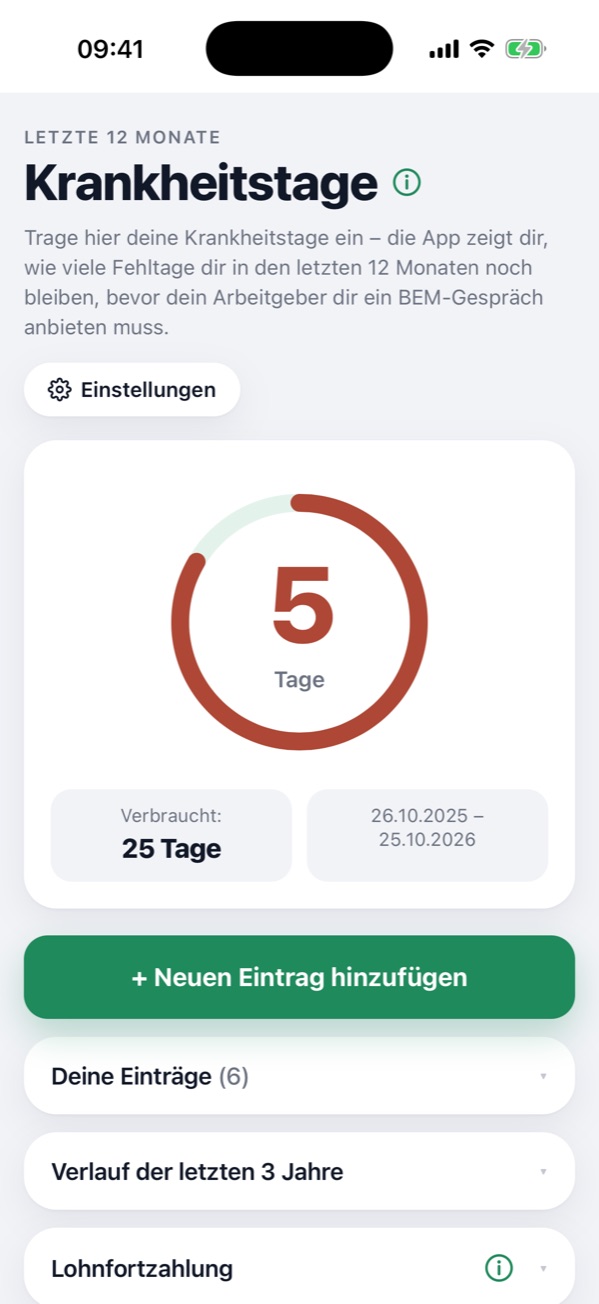
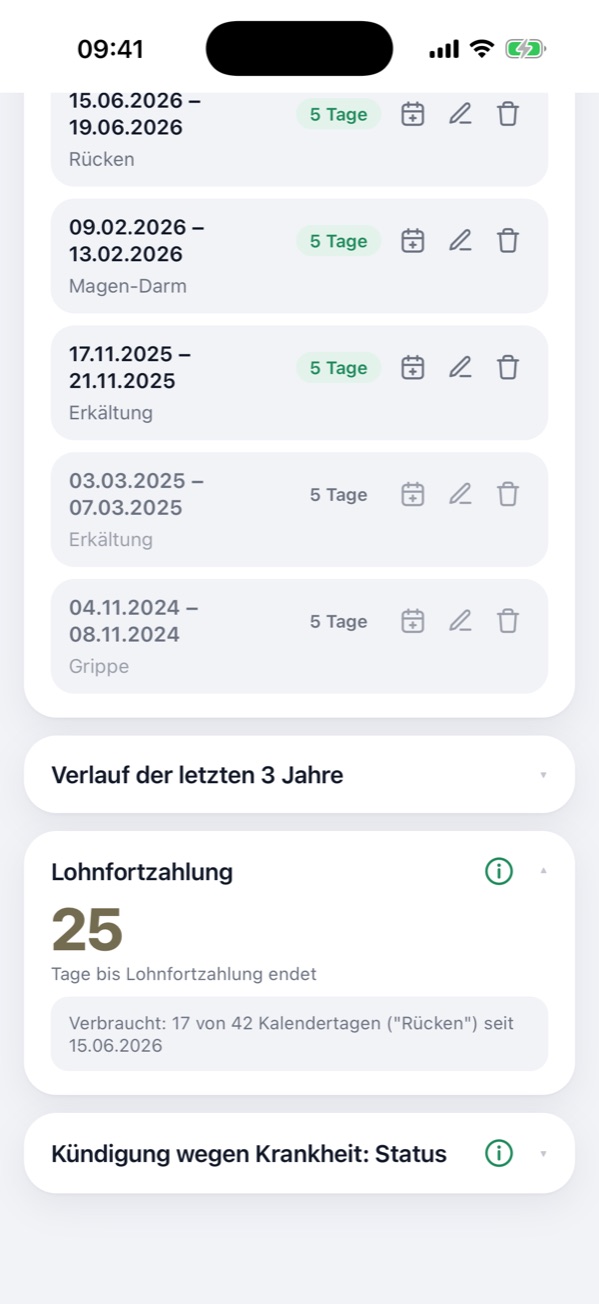
Krankheitstage keeps count for you
Enter your sick days in the calendar – the app calculates everything described on this page:
- Days left until the BEM threshold – rolling over twelve months, based on your workdays and the public holidays of your federal state.
- Fresh start after the BEM: enter the date, and the app starts counting again from the next day.
- Continued pay: how many of the 42 days are left for an illness.
- Trend of the last three years as an overview for the health prognosis.
- Your data stays on your device – no account, no ads, no tracking, works offline. In nine languages.
Why this app exists
I was ill for a long time myself – and had no overview of my sick days, the BEM threshold and continued pay. That’s how this app came about. The story in one minute:
Ideas, found a bug or questions about the app? Message me WhatsApp or by email: info@krankheitstage.com
The web app runs on any phone and computer. On iPhone, you can add it to your home screen in Safari via Share → Add to Home Screen and use it like an app.
Important: the web version has no protection against screenshots and no app lock. Your data is stored only in this browser – back it up regularly via export in the app options.
Frequently asked questions
Do weekends and public holidays count as sick days?
For the BEM threshold with repeated illnesses, your workdays count in practice – 30 workdays for a 5-day week. If you are ill without a break, calendar days count: more than 42 days. The 42 days of continued pay are also calendar days.
Do I have to take part in the BEM?
No. The BEM is voluntary for you. Declining has no direct consequences – but in a later unfair dismissal case, the employer can point out that a BEM was offered.
Do I have to tell my employer what illness I have?
No. The sick note for your employer does not contain a diagnosis, and in the BEM you decide yourself what you reveal about your health. One exception: if your employer disputes whether it is the same illness (important for the 42 days of continued pay), you must, in case of dispute, show which illnesses you had – for example by releasing your doctor from confidentiality to that extent.
Can I be dismissed while on sick leave?
Yes, sick leave does not protect you from dismissal. Whether the dismissal is valid is another question – the three stages and the three-week deadline for a claim apply. Important: if your employer dismisses you because of your illness, continued pay must still be paid until the end of the six weeks – even beyond the end of the employment (§ 8 EFZG).
What happens when the six weeks of continued pay are over?
If you have statutory health insurance, you receive sickness benefit (Krankengeld) from your health insurance fund: 70 % of gross pay, at most 90 % of net pay. People with private insurance only receive daily sickness allowance if it is part of their contract.
Does the calendar year count or the last twelve months?
For the BEM, what counts is the last twelve months – rolling from today, not the calendar year. A day off sick last autumn can therefore still count today.
Does rehab count as sick days?
For continued pay, yes: during approved medical rehabilitation your employer keeps paying your salary as during an illness, and the days count towards the 42 days – if the rehab belongs to the same illness, towards that illness (§ 9 EFZG). As you are usually unable to work during rehab, it generally also counts towards the BEM threshold. Best enter it with the same note as the illness.
What if I fall ill during my holiday?
Days on which you were provably ill are not used up as holiday – you get them back. You need a doctor’s certificate for this, also abroad (§ 9 BUrlG). Inform your employer immediately. These days are normal sick days and count towards the BEM threshold and the 42 days of continued pay.
Do days off for a sick child count as my sick days?
No. If you stay at home because your child is ill, you yourself are not unable to work – these days count neither towards the BEM threshold nor towards your 42 days of continued pay. Instead of salary, you usually receive child sickness benefit (Kinderkrankengeld) from your health insurance fund (as a rule 90 % of the lost net pay). In 2026 each parent is entitled to 15 days per child, single parents to 30 – at most 35 or 70 days a year (§ 45 SGB V).
What applies after an accident at work?
After an accident at work or on the way to work, your employer first continues to pay your salary for up to six weeks. After that, it is not the health insurance fund but the employers’ liability insurance association (Berufsgenossenschaft) that pays injury benefit (Verletztengeld): 80 % of gross pay, at most your net pay (§ 47 SGB VII). For the BEM threshold, the days count like any other incapacity for work. If possible, see a specialist accident doctor (D-Arzt) and tell them it was an accident at work.
Am I still on sick leave during a graded return to work (Hamburg model)?
Yes. In a graded return to work you start with a few hours according to a plan and increase slowly – legally you remain unable to work (§ 44 SGB IX). During this time you usually continue to receive sickness benefit (or transitional benefit) instead of salary. The days therefore still count as sick days – also for the BEM threshold.
Do I get continued pay in the first four weeks of a new job?
No. The entitlement only arises once your employment has lasted four weeks without interruption (§ 3 EFZG(3)). If you are ill before then, people with statutory health insurance usually receive sickness benefit from their health insurance fund. If the illness lasts longer, your employer pays from the fifth week for up to six weeks.
Can my employer ask for a sick note from the first day?
Yes. By law you only need a doctor’s certificate if you are ill for more than three calendar days – but your employer may ask for it earlier, for example from the first day (§ 5 EFZG(1)). This may also be stated in your employment contract or collective agreement. In any case, you must report sick immediately.
The laws in full (in German)
- § 167 SGB IX – Workplace reintegration management
- § 3 EFZG – Entitlement to continued pay
- § 5 EFZG – Duty to notify and provide evidence
- § 47 SGB V – Amount of sickness benefit
- § 48 SGB V – Duration of sickness benefit
- § 1 KSchG – Socially unjustified dismissals
- § 4 KSchG – Deadline for filing a claim
- § 23 KSchG – Scope of application
- § 168 SGB IX – Approval of the Integration Office